SETI (Sustainable Energy Transition in Indonesia)
Status
Ongoing
Overall Project Duration
Commissioner
IKI , BMUKN
Political Partner
Ministry of Energy and Mineral Resources – Directorate General of New Renewable Energy and Energy Conservation (DJ EBTKE, ESDM)
Cooperation Partners
CERAH, Institute for Essential Services Reform (IESR), World Resources Institute (WRI), Institute for Research on Economics and Society – Faculty of Economics and Business, University of Indonesia (LPEM FEB UI), Fraunhofer Institute for Systems and Innovation Research ISI
Implementing Organization
GIZ
Project page on organization website
Project Documents and Links
- N/A
Decarbonising industry and the built environment through acceleration of renewable energy and energy efficiency
Project Approach
Aligned with the Government of Indonesia (GoI) plan, SETI will implement several mitigation actions to accelerate renewable energy (RE) and energy efficiency (EE) in industries and the building sector. SETI will focus on increasing capacities for a sustainable transition by raising awareness among stakeholders, providing technical assistance and training at various levels, and facilitating matchmaking with financial institutions and technology providers. In addition to supporting the achievement of the JETP, SETI will contribute to derivative regulations of PP 33 on Energy Management and assist the Ministry of Mineral and Energy Resources (ESDM) in exploring how carbon mechanisms can aid the energy transition while decarbonizing the industry and building sectors. SETI will work with both political stakeholders and private sector champions to drive the uptake of RE and EE measures in businesses. In summary, SETI will contribute to three main pillars.
Desired Impacts
The demand-based ecosystem approach of SETI will lead to concrete emission reductions from renewable energy (RE) and energy efficiency (EE) pilot implementations, trigger investments from both public and private sectors, and provide scalable solutions for the energy transition. Thus, SETI will contribute to reducing greenhouse gas emissions in Indonesia through an effective institutional, regulatory, and financial ecosystem, demonstrating Indonesia’s commitment to a sustainable energy transition.
Project Activity Areas (Outputs)
Policy Development
Capacity Building
Support for Pilot Cities and Industry Champions to achieve sustainable energy
Financial Instrument Support
Project Publications
Project Updates
Tools
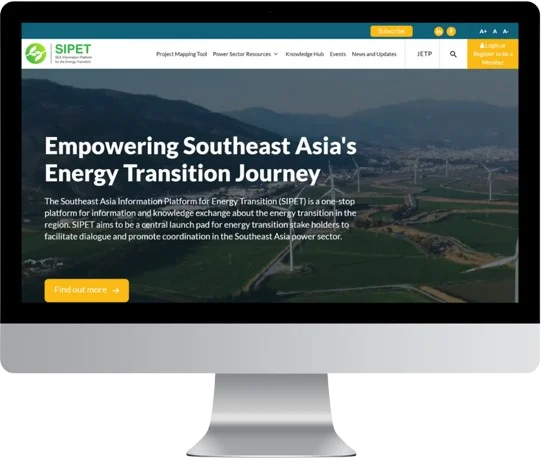
SEA Information Platform for the Energy Transition (SIPET)
The Southeast Asia Information Platform for Energy Transition (SIPET) is a one-stop platform for information and knowledge exchange about the energy transition in the region. SIPET aims to be a central launch pad for energy transition stake holders to facilitate dialogue and promote coordination in the Southeast Asia power sector.
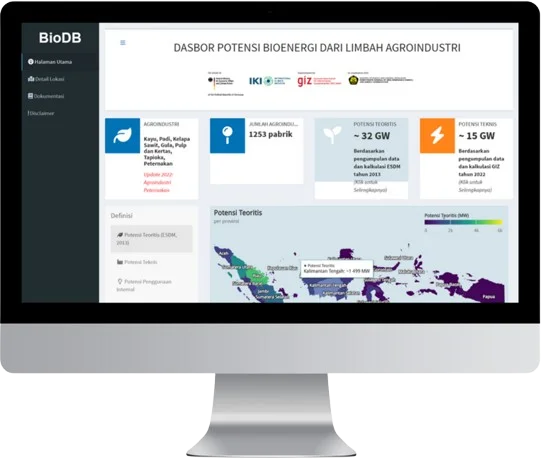
Bio DB
BioDB is a useful website for providing general information, encouraging discussion and conversation on the topic of bioenergy from agro-industrial waste. The data and information presented were collected by the Strategic Exploration of Economic Mitigation Potentials through Renewables (ExploRE) project, a project funded by the Federal Ministry for the Environment, Nature Conservation and Nuclear Safety (BMU), Federal Republic of Germany, in collaboration with the Ministry of Energy and Mineral Resources (ESDM) of the Republic of Indonesia, and implemented by the Deutsche Gesellschaft für Internationale Zusammenarbeit (GIZ)
IKI JET
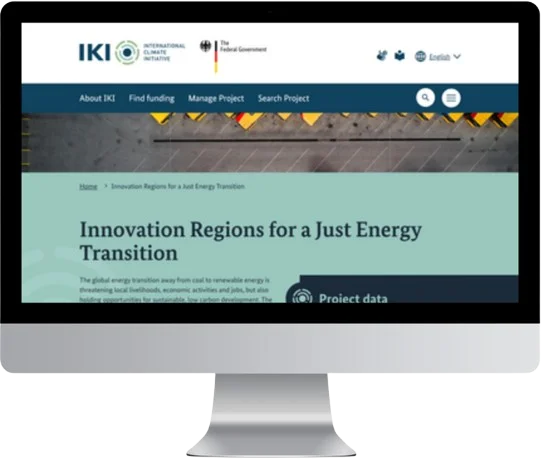
The global energy transition away from coal to renewable energy is threatening local livelihoods, economic activities and jobs, but also holding opportunities for sustainable, low carbon development. The project aims at supporting key stakeholder of coal regions to plan for and implement regional just energy transition pathways away from coal and towards a low-carbon energy system. Focusing on the regional economic transformations, the project works with government, industry, unions, communities, civil society, and academia. It supports interregional peer-to-peer exchange, learning, and policy dialogue in an international network and information sharing via a knowledge hub. In Indonesia, it supports the development of specific transition plans in two coal regions. In Colombia, it supports the development of the concept and framework for energy communities and the implementation of just and inclusive energy communities in César and la Guajira.
CASE for Southeast Asia
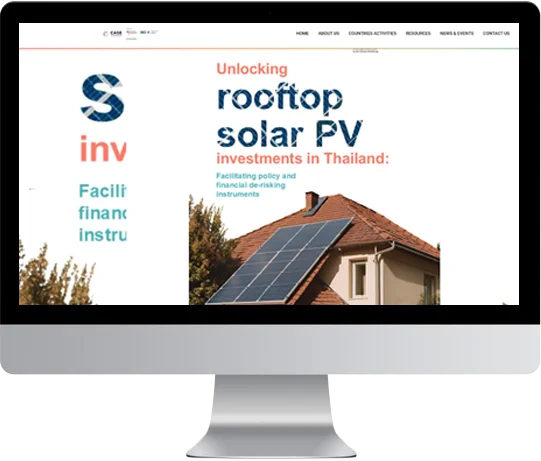
The “CASE for Southeast Asia” website is dedicated to the promotion of clean, affordable, and secure energy transitions across Southeast Asia. The website focuses on the provision of resources, the conducting of research, and the facilitation of collaborative projects in countries such as Indonesia, Thailand, the Philippines, and Vietnam, with the aim of supporting energy transition efforts. The platform highlights the challenges and opportunities in the region’s energy sector, while sharing knowledge, best practices, and policy recommendations aimed at advancing the transition to renewable energy and sustainable development
Contact
Project Address
De Ritz Building, Floor 3A
Jl. HOS Cokroaminoto No. 91, DKI Jakarta, Indonesia
Dr. Johannes Anhorn
Implementation Manager SETI